BBCPy_DNN
- Python
- PyTorch
- PyTorch Lightning
- Hydra
- Optuna
- MLflow
- EEG / BCI
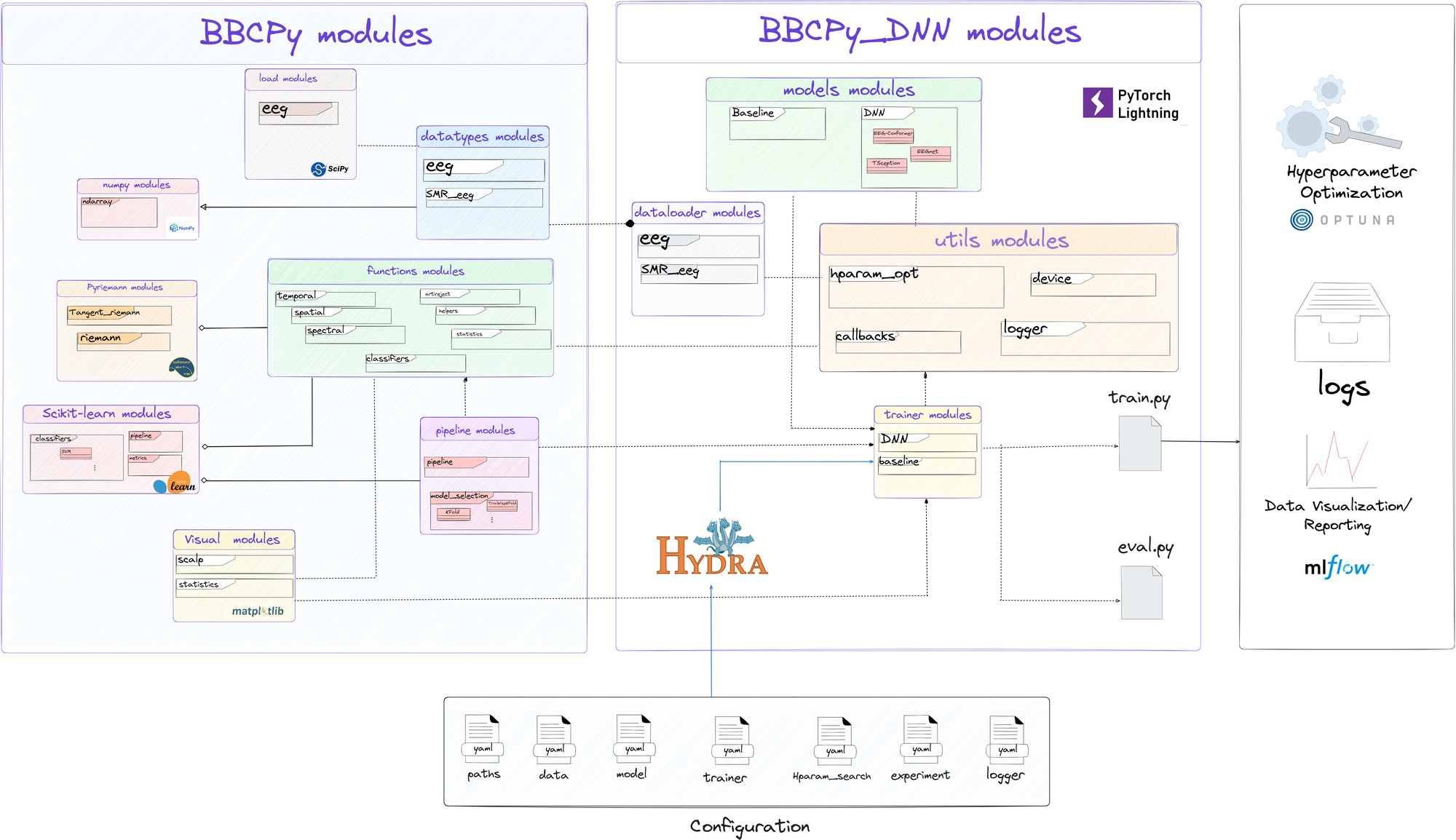
BBCPy_DNN is an integral component of the BBCPy toolbox, designed to facilitate the development and exploration of Deep Neural Networks (DNNs) within the PyTorch framework. It supports a lifecycle that seeks to cultivate the best-performing models, delivering superior results through continuous improvement.
Why it exists
Motor imagery-based brain-computer interfaces (MI-BCIs) represent a significant paradigm within the field of neurotechnology, particularly for individuals with paralysis. By mentally rehearsing motor movements, MI-BCIs facilitate control over prosthetic limbs or wheelchairs. Building a classifier for MI-BCI applications involves complex processing and feature extraction from brain signals to distinguish between different mental states.
BCI is inherently multidisciplinary, demanding expertise not only in neuroscience, machine learning and electrical engineering but also in software development. Integrating these disciplines calls for a comprehensive toolbox that covers the standard methods and is regularly updated with new datasets and algorithms, so scientists and engineers can prototype and develop algorithms quickly. Given the growing role of deep learning, my thesis introduced a deep learning interface incorporated into an existing BCI toolbox. It streamlines the development and training of neural networks and follows a more automated, standardized machine learning lifecycle.
Benchmark data
Using the Sensorimotor Rhythm (SMR) dataset, the largest open BCI dataset available (EEG from 62 healthy participants, four classes: left hand, right hand, both hands, rest), the thesis integrated it into BBCPy as a standard resource and used it as the benchmark for evaluating deep learning models on the motor-imagery classification task.
How it’s built
- PyTorch Lightning trainers for baseline and DNN models (EEGNet, TSception, EEG-Conformer).
- Hydra configuration (paths, data, model, trainer, hyperparameter search, experiment, logger) so experiments change without touching source code.
- Optuna hyperparameter optimization and MLflow experiment tracking and reporting.
- Reuses BBCPy’s EEG data types, SMR loaders and scikit-learn-style pipelines and model selection.
Context
This toolbox was developed during my master’s thesis as part of The Berlin Brain-Computer Pynterface (BBCPy) project by the Neurotechnology Group at TU Berlin. BBCPy is engineered as a versatile system for BCI applications, suitable for both offline analysis and online experiments.