Avecina (Viaticum)
- FastAPI
- React
- Gemma-3 LoRA
- GLiNER2
- Parakeet ASR
- OpenSearch RAG
- GCP
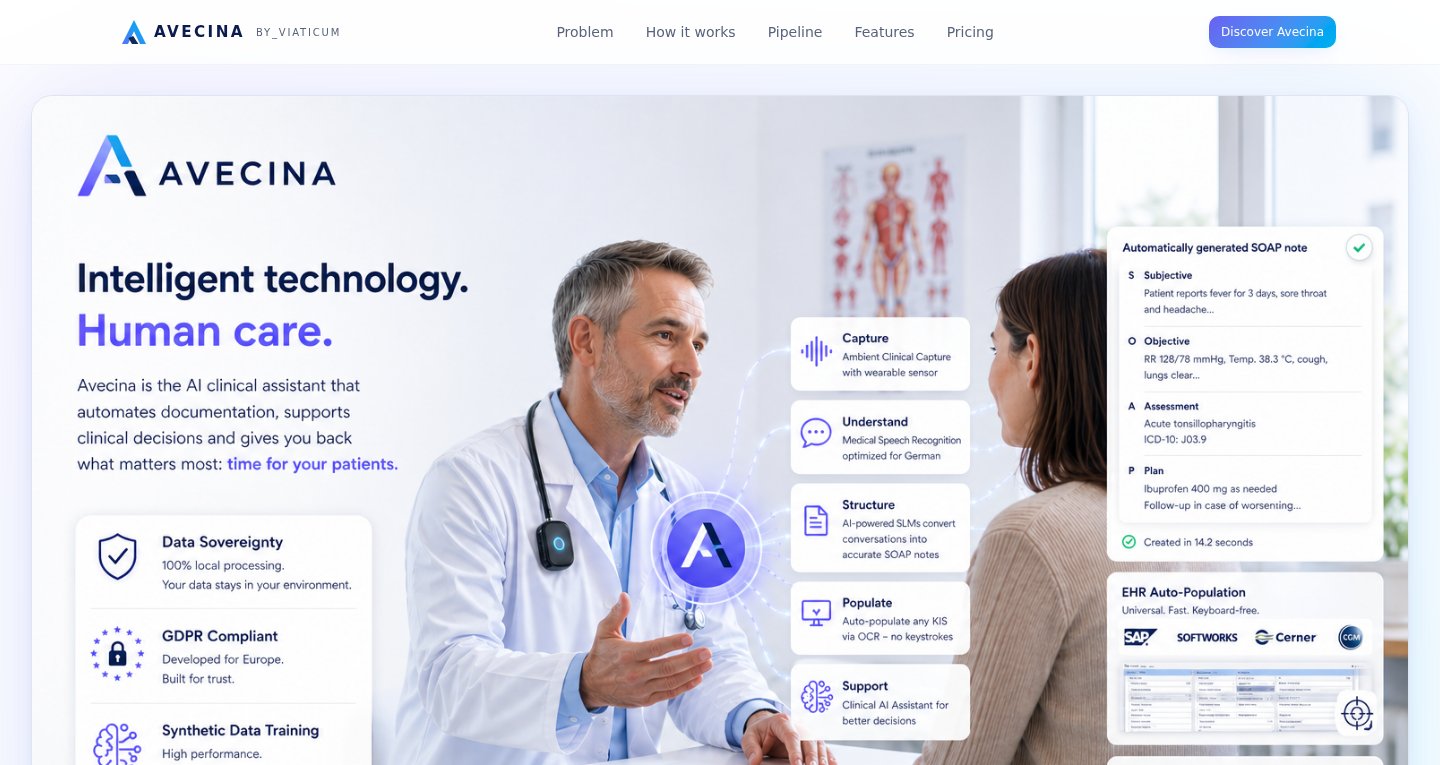
Avecina is a healthcare AI prototype that reduces the documentation burden on doctors and nurses. It listens to a doctor–patient consultation, transcribes it in German medical language, structures it into a SOAP note and helps transfer it into the hospital information system (KIS). The clinician always reviews and approves the result.
The problem
German hospital physicians spend a large share of their day on documentation, re-entering information across disconnected, often API-less systems such as SAP IS-H, ORBIS and CGM. Most medical AI scribes are English-first and cloud-only, which makes them hard to deploy inside German hospital networks.
Core idea: capture audio, process it close to the hospital, and write back into the existing KIS user interface instead of waiting years for vendor API access.
What I built
Built in two days at the Berlin Big Hackathon 2026 and extended afterwards:
- Ambient capture: an Omi wearable pin (or a
.wavsimulator) streams PCM-16 / 16 kHz audio over WebSocket. - Dual-redundant speech-to-text: Parakeet-DE-Med on a GCE T4 GPU as primary, the Gradium streaming API as fallback, plus a demo stub, all behind one router so the pipeline degrades gracefully.
- Fine-tuned NLP: GLiNER2-DE-Med (205M) extracts 7 medical entity types; a Gemma-3-4B LoRA model turns the transcript into structured SOAP JSON. Both were trained on synthetic German data on the Pioneer platform, so no real patient data was used.
- RAG: BAAI/bge-m3 embeddings in an OpenSearch k-NN index with a German analyzer, plus PostgreSQL and Firestore for patients, chat history and SOAP records.
- Hakîm AI companion: FastAPI endpoints for SOAP drafts with confidence, colour-coded entity chips and RAG Q&A with citations.
- Mock KIS frontend: 12 German-language React screens with a typewriter form-fill that shows the hand-off into the hospital system.
Engineering decisions
- Model per task: small, fine-tuned models for German ASR, NER and SOAP generation instead of one frontier LLM: cheaper, deterministic and deployable on modest hardware.
- Non-invasive integration: OCR / UI automation over the existing KIS screens instead of vendor-specific backend integrations.
- Privacy-first architecture: the proof of concept runs on Google Cloud (EU); fully on-premise deployment is the production goal.
Roadmap
- Ambient documentation copilot: conversation → SOAP notes, codes and KIS entry, human-reviewed.
- Hospital data layer: extract labs, reports and scans into validated JSON mapped to HL7 FHIR.
- Agentic coordination: permission-scoped agents for clinical and operational teams, with explicit human authorization for anything sensitive.
Hackathon proof of concept and MVP, not a clinically validated or deployed medical device.