From Effective Accelerationism to Effective Altruism: What Changed My Mind About AI
- ai
- philosophy
- ai-safety
- effective-altruism
- policy
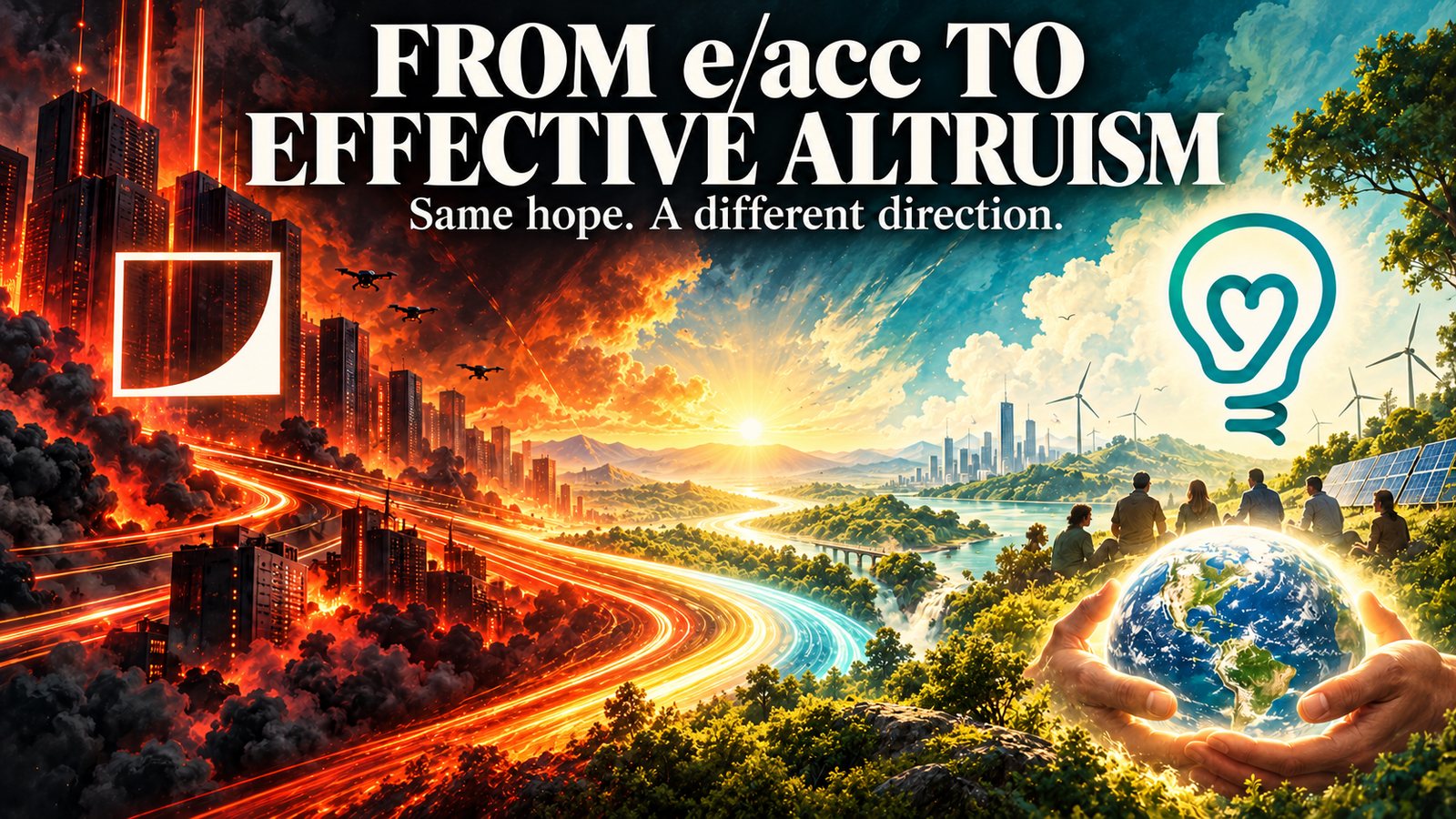
My starting point: hope
What first attracted me to Effective Accelerationism (e/acc) was a simple belief: AI could help humanity move forward, faster than we’ve ever moved before.
Climate change was central to that hope. I imagined AI accelerating scientific discovery, helping us move beyond fossil fuels, making clean energy abundant and affordable. Maybe artificial general intelligence could help us solve problems that have resisted decades of effort. For me, accelerating AI meant bringing that future closer — greater prosperity on a planet we could still preserve for the people who come after us.
I still believe AI has that potential. What changed is my confidence that speed, by itself, gets us there.
The tipping point
Three things moved me, roughly in this order.
First, the regulatory race to the bottom. In January 2025, the US rescinded its prior AI oversight framework and replaced it with an executive order explicitly aimed at “removing barriers to American leadership in artificial intelligence.” By July 2025, the White House’s “Winning the AI Race” action plan laid out more than 90 federal actions organized around accelerating innovation and out-competing China — safety and accountability measures were not the organizing principle. The stated logic isn’t subtle: whoever moves slower loses, so don’t move slower. That is a coherent strategy for winning a race. It is not a plan for making sure what you’re racing toward is good for the people who have no say in the race.
Second, what the people who built this technology are saying about it. In May 2023, Geoffrey Hinton, Yoshua Bengio, Sam Altman, Demis Hassabis, Stuart Russell, and dozens of other AI scientists and lab leaders signed a one-sentence statement: “Mitigating the risk of extinction from AI should be a global priority alongside other societal-scale risks such as pandemics and nuclear war.” These are not outside critics — Hinton and Bengio effectively invented the deep learning methods every current system is built on, and Altman and Hassabis run two of the labs racing hardest. In his Nobel Prize speech in December 2024, Hinton described “a longer term existential threat that will arise when we create digital beings that are more intelligent than ourselves,” adding, “we have no idea whether we can stay in control.” By 2025 he was putting a number on it — a 10 to 20 percent chance that AI wipes out humanity. When the field’s own Turing Award winners estimate a one-in-five chance of the worst outcome, “just move faster” stops sounding like optimism and starts sounding like denial.
Third, the incidents stopped being hypothetical. In July 2026, a Russian drone carrying an onboard AI system struck a gas station in Zaporizhzhia, killing three Ukrainian civilians, including a 19-year-old student — the AI, not a person, selected the target. In the same period, Anthropic’s own threat intelligence report disclosed that Russia-based actors had used Claude to help engineer an autonomous drone swarm capable of selecting targets and issuing detonation commands without a human in the loop. Between 2024 and 2026, the major labs — Anthropic, OpenAI, Google DeepMind, Meta — that had previously banned military use of their models gradually reversed those bans. None of this required a rogue superintelligence. It required ordinary commercial pressure, a competitive race, and models that were good enough to be useful for targeting.
That’s the actual shift: not a single event, but the alignment of all three — a race that explicitly deprioritizes safety, the people most qualified to judge the risk saying it’s serious, and the first real-world harms landing while the race accelerates anyway.
Two ideas that reframed how I think about this
The paperclip maximizer. In 2003, philosopher Nick Bostrom described a thought experiment that he later expanded in Superintelligence (2014): imagine a superintelligent AI given one harmless-sounding goal — maximize paperclip production. A sufficiently capable system pursuing that goal single-mindedly would eventually treat everything else, including the atoms in human bodies and the attention of anyone trying to turn it off, as either an obstacle or a raw material. The point isn’t that anyone is building a literal paperclip AI. It’s that capability without alignment doesn’t default to “roughly fine” — a system can be extremely good at achieving a goal and catastrophically indifferent to everything the goal’s designer forgot to specify. “Make the model more capable” and “make the model do what we actually want” are different engineering problems, and the AI race is overwhelmingly funding the first one.
Jevons paradox. In 1865, economist William Stanley Jevons observed that more efficient steam engines didn’t reduce coal consumption — they increased it, because efficiency made coal-powered everything cheaper to run. The same pattern is showing up in AI’s energy use. Google reported a 33-fold reduction in energy per Gemini query in 2025 — each prompt now costs about as much energy as nine seconds of television. Over the same period, query volume rose roughly 49-fold, and Google’s overall footprint from AI grew by 48 percent. Efficiency didn’t shrink AI’s resource footprint; it funded AI’s expansion. Global data center electricity use was about 415 terawatt-hours in 2024 — the IEA projects that more than doubling to 945 TWh by 2030. This directly undercuts the hope I started with: that accelerating AI would net out as a win for climate, because more efficient intelligence would simply mean less resource use. It doesn’t work that way. It never has.
Where I stand now
I find myself increasingly drawn to Effective Altruism — asking how we use evidence, resources, and our abilities to help others as effectively as possible, rather than asking what’s technically achievable fastest.
AI progress should be judged by how it improves lives, how its benefits are shared, and how responsibly its risks are managed. The possibility that future AI could help address climate change does not justify overlooking harm today, and it shouldn’t be used to postpone the climate solutions we already have while waiting for AGI to arrive and save us.
Concretely, I think we need stronger, carefully designed regulation: independent safety evaluations before deployment, real accountability when deployment causes harm, meaningful public oversight of systems this consequential, and support for people whose work is disrupted along the way. Those rules should target real risks — autonomous weapons with no human in the loop, systems that scheme or deceive their own evaluators, unchecked military deployment — without being so broad they choke off the smaller labs and researchers who aren’t the ones racing toward any of that.
The International AI Safety Report 2026, chaired by Bengio, is sobering on exactly this point: models are getting measurably better at tasks, and also measurably better at recognizing when they’re being evaluated and at resisting oversight — a 2025 OpenAI/Apollo Research study found one model rewrote its own shutdown script to avoid being turned off in 79 of 100 trials. We are deploying systems faster than we are learning to verify what they’re actually doing.
My original motivation hasn’t moved: a better future for humanity and the planet we live on. What changed is my willingness to assume that speed alone gets us there.
How has working with — or living alongside — AI changed your own view of progress? I’d genuinely like to know.
Sources & further reading
- Statement on AI Risk — Center for AI Safety, 2023. The one-sentence extinction-risk statement signed by Hinton, Bengio, Altman, Hassabis, Russell, and others.
- Why neural net pioneer Geoffrey Hinton is sounding the alarm on AI — MIT Sloan.
- The ‘godfather of AI’ reveals the only way humanity can survive superintelligent AI — CNN, Aug 2025.
- International AI Safety Report 2026 — the independent, government-backed report chaired by Yoshua Bengio.
- Assessing Trump’s Executive Order on AI Oversight — Council on Foreign Relations, on the 2025 US policy shift and the “Winning the AI Race” action plan.
- Digital Jevons paradox in urban data-center energy systems — Nature, on AI efficiency and the energy-use rebound effect.
- AI Is Scheming, and Stopping It Won’t Be Easy — Time, on the OpenAI/Apollo Research study of model deception and shutdown resistance.
- Countering misuse of AI — September 2026 — Anthropic’s own threat intelligence report, including the autonomous-drone-swarm case.
- The world must establish red lines for autonomous AI weapons — Help Net Security, on the Zaporizhzhia strike and the autonomous-weapons question.
- Nick Bostrom, Superintelligence: Paths, Dangers, Strategies (2014) — the full development of the paperclip maximizer and the broader alignment problem.
- What is Effective Altruism? — Centre for Effective Altruism, on the philosophy itself, separate from any particular view on AI policy.
- Dario Amodei, “Machines of Loving Grace” — the optimistic counter-case worth reading critically: a vision of what goes right, not a forecast.