Brain-to-Text: Decoding Handwriting from Neural Activity
- bci
- neurotechnology
- deep-learning
- rnn
- paper-summary
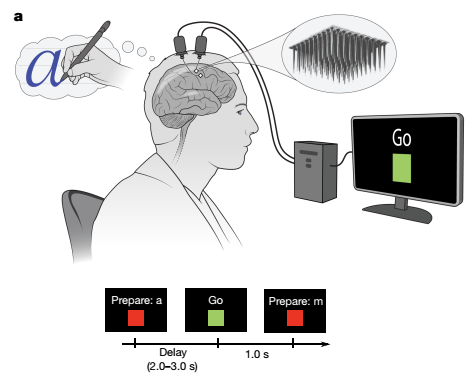
Originally written in March 2024 for my first portfolio. Summary of Willett et al., “High-performance brain-to-text communication via handwriting”, Nature 593 (2021).
Introduction
In recent years, advances in neural decoding techniques have shown promise in restoring communication and motor function in individuals with severe neurological impairments. In this post I walk through a case study of neural decoding applied to handwriting in a participant (T5) with a spinal cord injury, showing the feasibility and potential clinical value of neural interfaces for people with motor disabilities.
In Brain-Computer Interface (BCI) research, significant strides have been made in assistive communication, primarily through point-and-click typing with a 2D computer cursor. A groundbreaking development came with intracortical BCIs. A notable study by the BrainGate research group explored controlling a cursor on a screen and typing on a virtual keyboard purely by modulating sensorimotor brain activity.
Before this work, the state of the art for intracortical typing was about 40 characters per minute. The handwriting approach more than doubled that, underscoring the transformative potential of neural decoding for people with severe neurological impairments who want to communicate quickly and independently.
Experiment setup and participant information
Before going into the handwriting BCI system and its algorithms, here is an overview of the experimental setup used in this research.
Participant information
The participant is a right-handed man, 65 years old, with a high-level (C4 AIS-C) spinal cord injury. Despite this impairment, he has full cognitive abilities and retains the capacity for mental motor imagery.
Experimental procedure
Two 96-electrode intracortical arrays are placed in the hand “knob” area of the participant’s left hemisphere, recording neural activity associated with motor function and motor imagery.
During the experiment, the participant sees a series of sentences on a screen and mentally attempts to write each one letter by letter, as if his hand were not paralyzed. This motor imagery is the basis for decoding brain activity into characters.
Task paradigm
- Session structure: 3–5 hour sessions, 2–3 times per week, with uninterrupted blocks of 5–10 minutes.
- Tasks: an instructed-delay paradigm, with sentence-writing blocks and rest periods.
Experiment setup
- Prompting: a computer monitor displaying the sentences or characters to write.
- Cueing: the switch from reading to writing is signalled by a green cue after a delay period.
Data collection
Data are collected in blocks of 5 to 10 minutes, each an uninterrupted series of trials. Every trial follows a delay paradigm in which visual cues mark the start of each phase. These cues synchronize the participant’s motor imagery with the protocol, which makes accurate decoding of the neural signals possible.
Neural signal recording
- Electrode arrays: two 96-electrode intracortical arrays (Neuroport arrays) in the hand “knob” area of T5’s left-hemisphere precentral gyrus.
- Signal processing: analog filtering from 0.3 Hz to 7.5 kHz, digitization at 30 kHz, common average reference filtering, and digital band-pass filtering from 250 to 3000 Hz.
Neural decoding methods
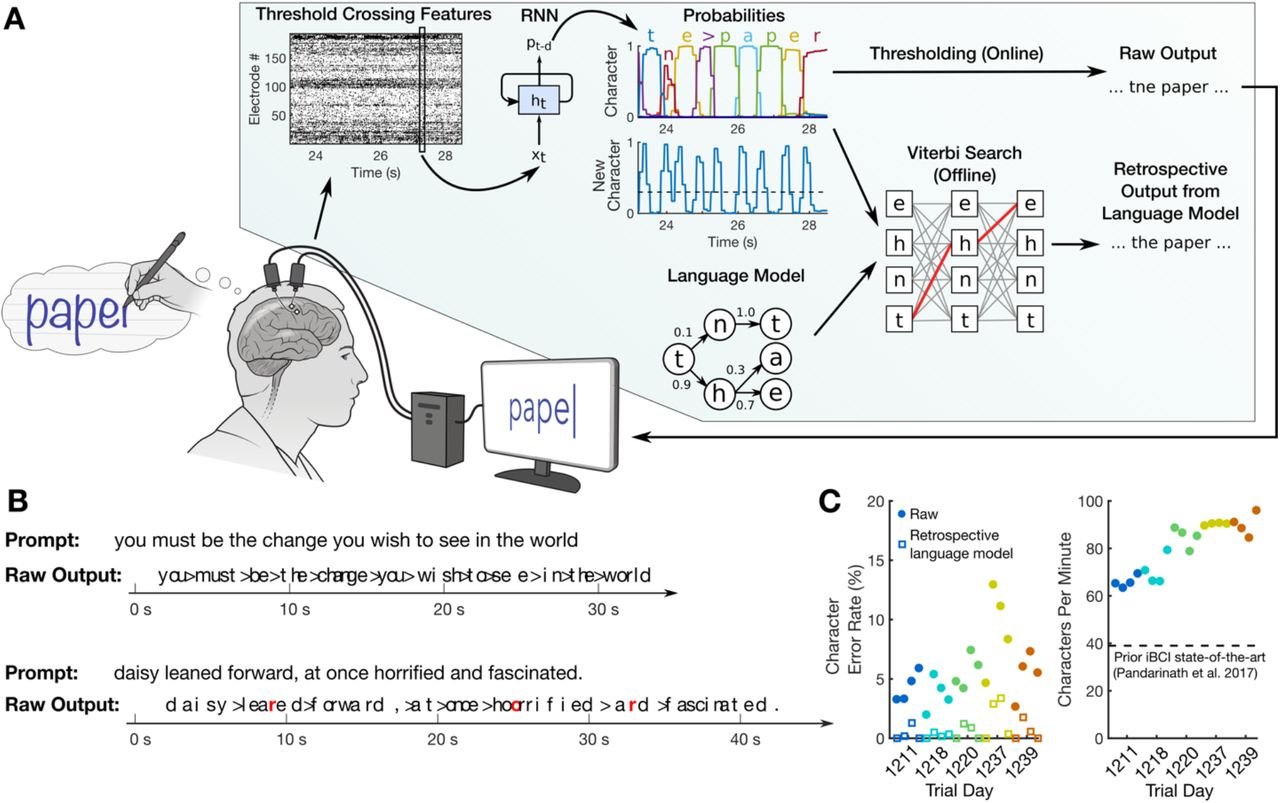
Neural activity is turned into threshold-crossing features per electrode. A recurrent neural network (RNN) reads these features over time and outputs, at every step, the probability of each character and of a new character starting. Online, thresholding these probabilities produces text in real time; offline, a Viterbi search with a language model corrects many of the remaining errors.